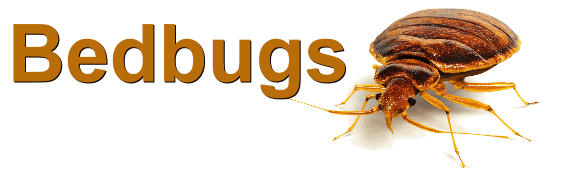
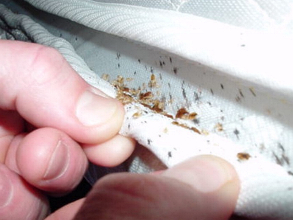
  Bedbugs are small wingless insects. They are a type of nocturnal parasite, resting during the day, hiding in the cracks and crevices of beds, box springs, headboards, bed frames and other objects around a bed. They come out to feed on human blood at night, although they may also bite during the day. Their mouth has evolved in such a way that allows bedbugs to easily pierce the skin without causing pain.
Bedbugs are about 5 mm long, with six legs and a flat, oval-shaped body. They do not have wings, and are light brown in colour, with a reddish tinge after feeding on blood. They have a small head, with large antennae and large mandibles in their mouth. Bedbugs are parasites that rely on blood to survive. They can feed on the blood of any mammal, although they prefer the blood of humans. Like mosquitoes, they are attracted to the warmth surrounding mammalian bodies and the carbon dioxide present in the victim's expelled breath. 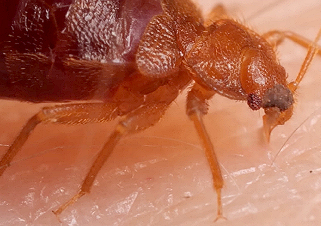 Bedbugs usually bite the upper body. The proboscis of the bedbug pierces the skin and allows the bedbug to feed on blood. The saliva of the bedbug, injected into the victim, contains an anticoagulant substance that keeps the blood flowing. It is this saliva that some people have an allergic reaction to. Bedbugs usually bite the upper body. The proboscis of the bedbug pierces the skin and allows the bedbug to feed on blood. The saliva of the bedbug, injected into the victim, contains an anticoagulant substance that keeps the blood flowing. It is this saliva that some people have an allergic reaction to. The feeding process takes about 10 minutes. The bedbug becomes filled with blood, changing in colour from light brown to rusty red. 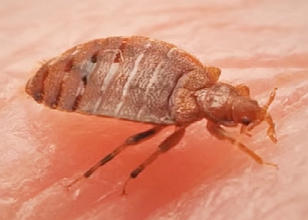
  Adult bedbugs, in general, are:
Bedbug eggs are tiny, about the size of a pinhead. They're pearl-white in colour. Young bedbugs (nymphs) are smaller, and translucent or whitish-yellow in colour. Unless they're recently fed, they can be nearly invisible. 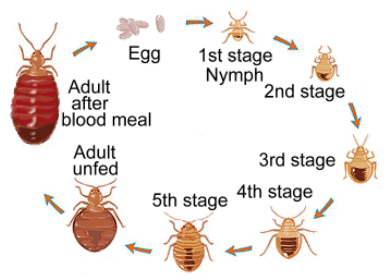 The Life Cycle of a Bedbug
 BedBug Anatomy 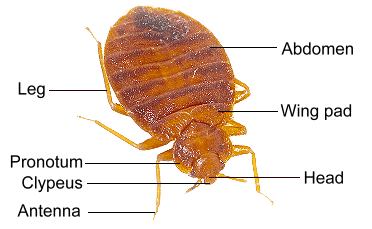 Antennae
Bedbugs use antennae as sensors to guide them towards sleeping victims, where the insect can feed. Each antenna has four segments, approximately half as long as the insect’s body. Clypeus The clypeus is part of the 'face' of an arthropod ... any invertebrate with an exoskeleton, a segmented body, and paired jointed appendages. Pronotum The pronotum is a concave-shaped structure that envelopes the head. Leg Bedbug adults can cover 1.2 metres in one minute. Each leg is tipped with a claw that can be used to grip rough surfaces, climb, and hold onto a host as they feed. However they lack suction pads, making it difficult for bedbugs to climb smooth surfaces. Head Bedbugs have short, wide heads, which attach to their thorax, the part where its legs attach to the body. Wing Pad Wing pads indicate where wings would usually develop as the insect matures. However, adult bedbugs have only vestigial wings which do not fully develop, so that the bedbug cannot fly. Abdomen There are 11 segments in a bedbug’s abdomen. As the bedbug feeds, these segments expand, allowing the blood being consumed to be stored. After a bedbug has fed, the abdomen will appear swollen and reddish in colour. The shape of a bedbug’s abdomen indicates whether the insect is male or female. Male bedbugs have a pointed tip at the rear of their abdomen, while females have a rounded tip. Bedbug Bites 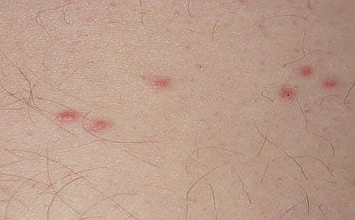 Symptoms of bedbug bites are similar to those of other insects. Bedbug bites are usually
inflamed spots, often arranged in a line or a cluster, and are often itchy. Bites can occur on the face, neck, arms and hands. Some people don't react to bedbug bites, while others experience a mild allergic reaction. Bedbug bites usually clear up without treatment in a week or two. Bedbugs aren't known to spread disease, but can cause a strong skin reaction in some people that can include severe itching, blisters or hives. Symptoms of bedbug bites are similar to those of other insects. Bedbug bites are usually
inflamed spots, often arranged in a line or a cluster, and are often itchy. Bites can occur on the face, neck, arms and hands. Some people don't react to bedbug bites, while others experience a mild allergic reaction. Bedbug bites usually clear up without treatment in a week or two. Bedbugs aren't known to spread disease, but can cause a strong skin reaction in some people that can include severe itching, blisters or hives.
|